The Academy of DungeoneeringStory games for working teams

From Baldur's Gate 3 to the table

Played Baldur's Gate 3? Pull up a chair.

You've gathered a party, weighed up a risky conversation and watched a twenty-sided die decide whether a clever plan worked.

You already know some of the ideas behind tabletop Dungeons & Dragons. Here's how they come to life around a table.

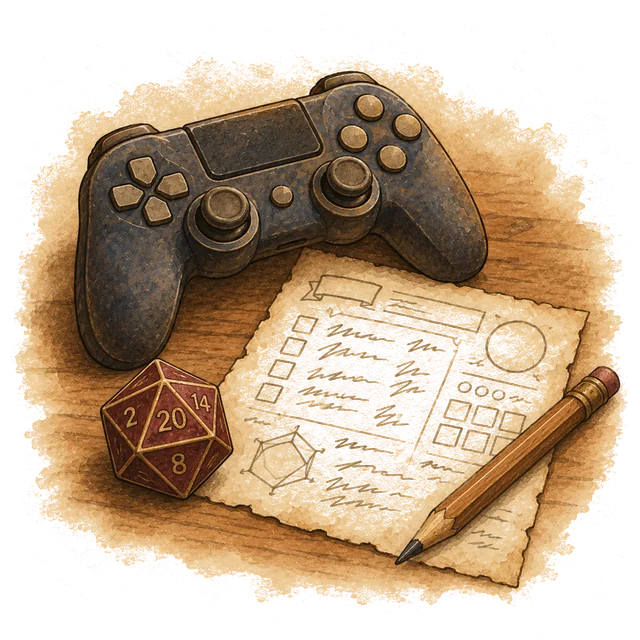
A video-game controller beside a character sheet, a pencil and a twenty-sided die.

A familiar starting point

The same ideas, at a table.

Baldur's Gate 3 is based on fifth-edition D&D. Characters have different strengths, spells and equipment. Resources run low. The party has to decide what matters, who should attempt something and when to try another approach. Those ideas will feel familiar when you play at the table.

In Baldur's Gate 3Around our table
Your character has abilities, equipment and limited resources.You have a character sheet and a few useful things to know. I'll help you understand them.
The party chooses an approach to a problem.You talk it through together and tell me what you want to attempt.
The game handles rules and rolls behind an action.I explain the relevant rule, guide any roll we need and describe the consequences.
Your choices and the results affect what happens next.We discover how the world responds and decide what to do about it.

I help with the numbers

Spend your attention on the problem.

When Gale casts a spell, the computer handles much of the work of checking rules, resolving rolls and showing what happened. At the table, I guide that process.

Tell me what you want your character to do. I'll explain what's possible, help with any roll or calculation and describe how the world responds. You'll learn the parts you need as we play.

You can explain your own idea

No menu of options.

You might want to distract a guard, talk your way into a locked building or use a spell in a way nobody at the table has considered.

Describe your approach in your own words. You can ask questions, combine ideas with another player and change your plan when you learn something new. I can respond as we go, including when your idea sends the adventure somewhere I hadn't expected.

We're on the same side

I play the world around you, including the people and creatures who oppose your characters. I also want your group to have a good game. My job is to present interesting challenges, apply the rules fairly and give your choices consequences. We're working together to make a story worth being part of.

Failure gives us somewhere to go

A good idea can carry a risk. A failed attempt might cost time, attract attention, use up a resource or force you to find another route. That uncertainty gives decisions weight, and we build on whatever happens together.

Say it, or play it

You can say, "I ask the guard who else came through this morning." You can also have the whole conversation in character if you enjoy that. Voices, costumes and acting are optional. Both ways of playing belong at the table.

A few things will work differently

Baldur's Gate 3 adapts D&D for a video game, so some spells, actions and other rules work differently at a tabletop. Ask about anything you recognise: I'll explain the version we're using and point out differences when they matter.

You can create a character of your own, within what the rules we're playing allow, or start with a ready-made one. Ready-made is the default for an introductory adventure, and we'll help you make it yours during play.

Ready to play?

Pull up a chair.

Sessions are available in Cambridge, London and online. We can come to your office or chosen venue, with travel included in Cambridge and London. Other locations and venue arrangements are quoted in advance.

Email us with your group size, two or three possible dates and where you'd like to play. We'll help you choose a first session.

hello@academyofdungeoneering.com

Open your email app
The Academy's house dragon: a small dragon curled asleep on a stack of old books beside a lit candle, one eye half open.