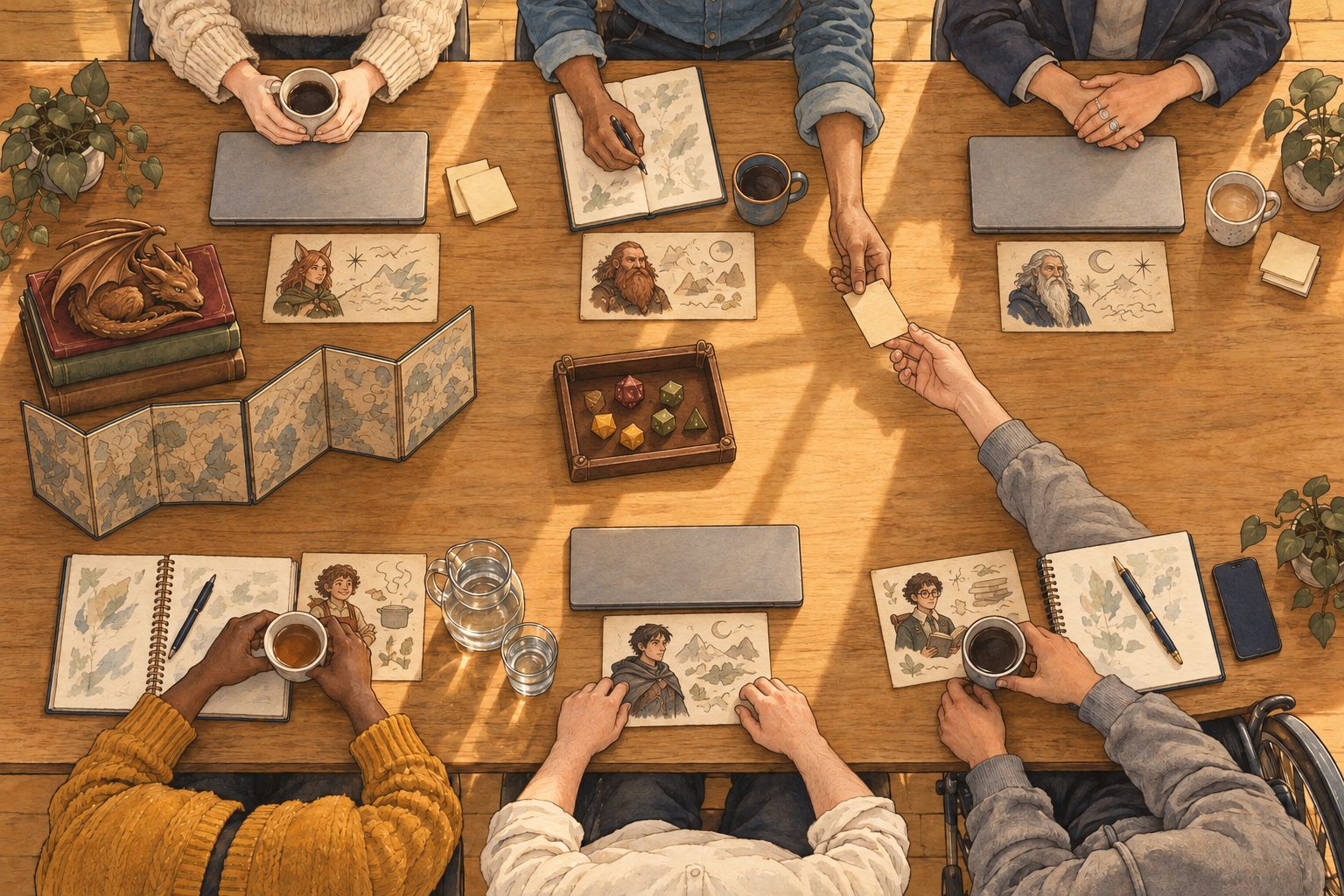
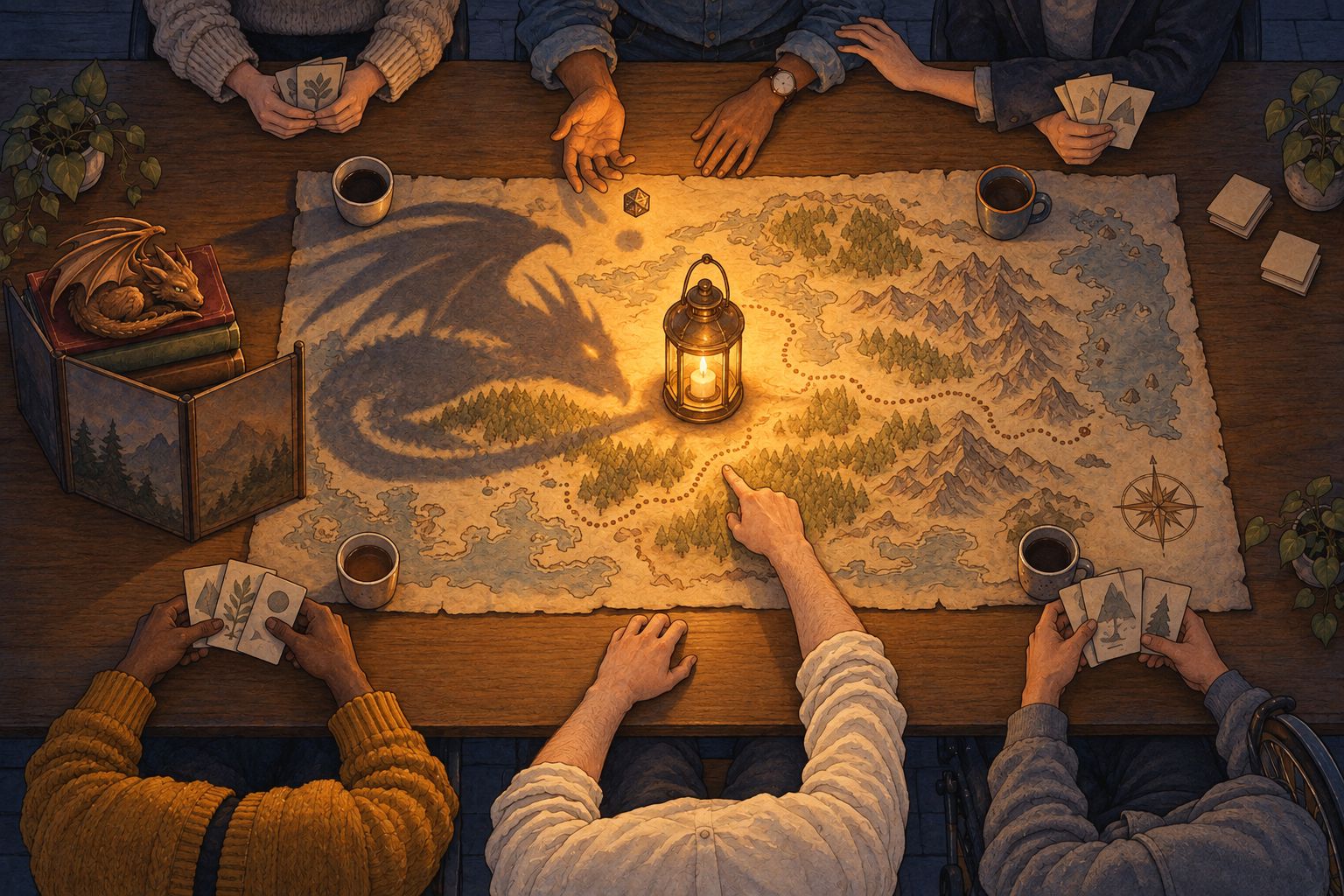
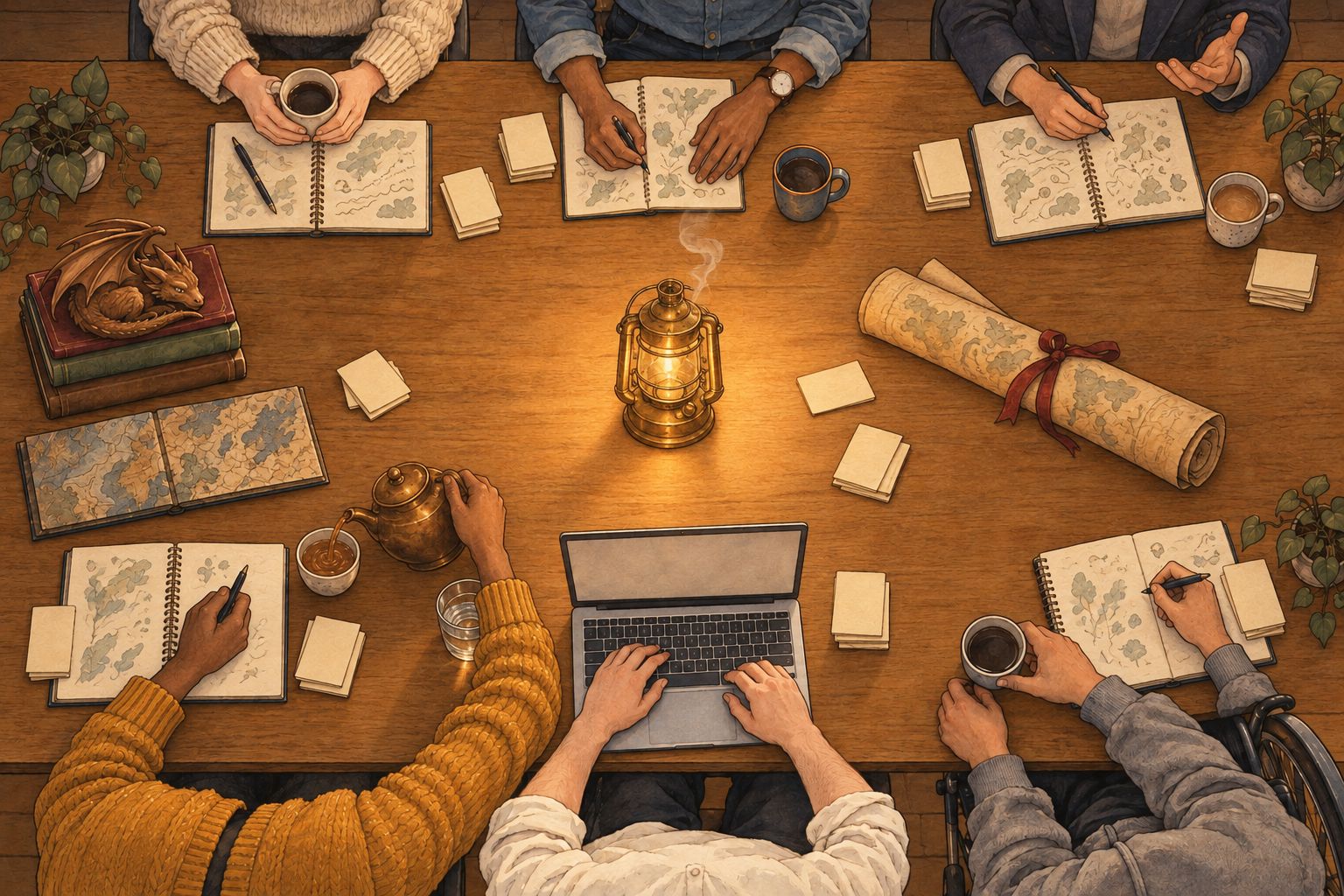
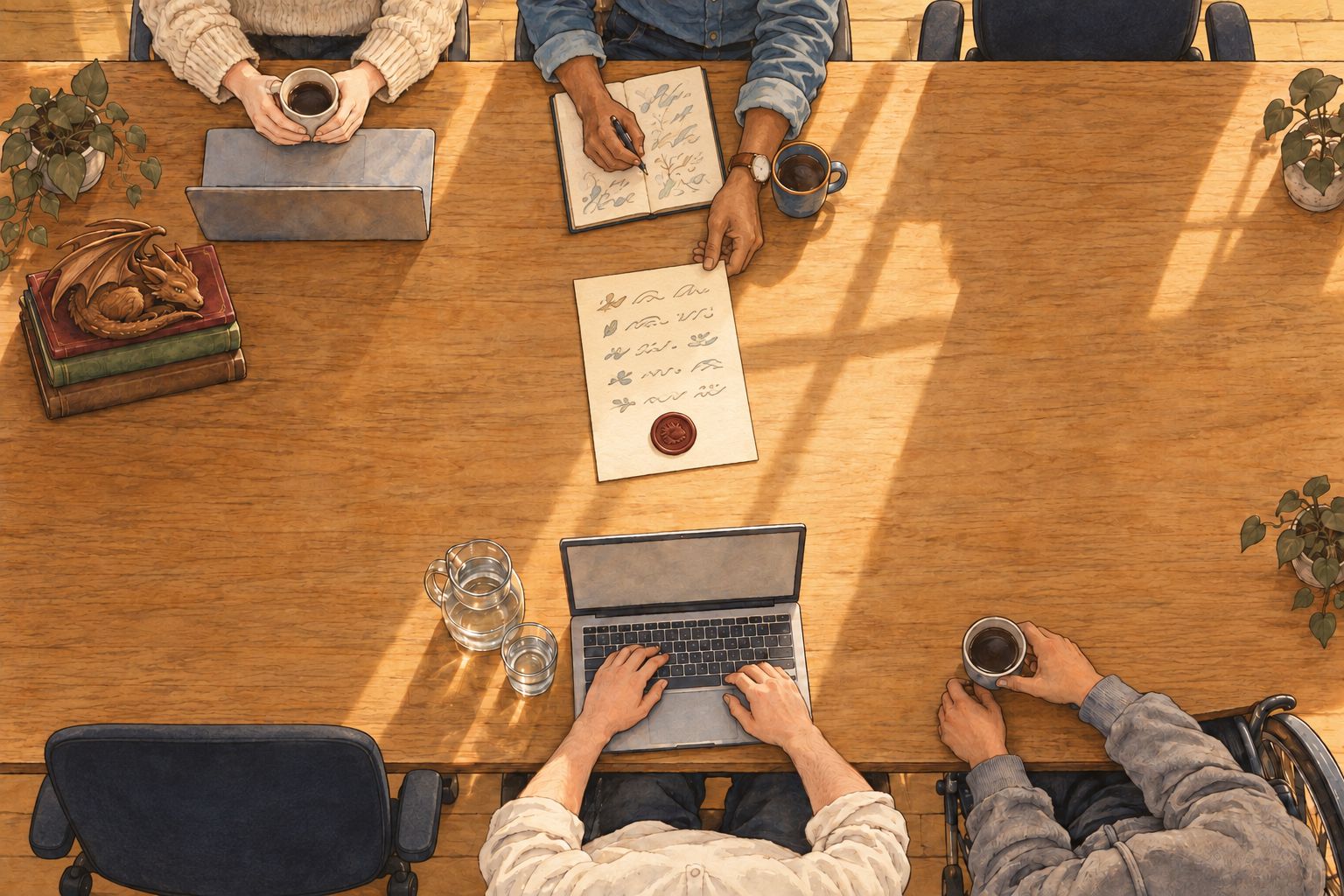
An ordinary meeting room.Characters chosen. Dice handed out.Deep in the story. The dragon is asleep. Probably.The lights come back up.Back at work. It's in writing.
Team sessions in Cambridge and online
A three-hour story game that shows your team how it works together.
One team of up to six, one cooperative story, and a game master, the person who runs the story and its rules. Then a debrief that turns what happened at the table into how you work on Monday.
Each player chooses a ready-made character from a one-page sheet and gets their own set of dice to keep. Then the table agrees what stays out of the story, and anyone can skip a scene later without giving a reason.
Session Zero is what game masters call these first fifteen minutes, when the table agrees how the game will go.
You don't need to have played before. I handle the rules.
The adventure · 1 hour 50 minutes
One problem, and it needs all of you.
The team faces one problem together: a heist, a rescue or a negotiation, in a fantasy world, among the stars or in a ghost story. Every challenge needs more than one person to solve it. Players say what their character does. The game master handles the rules and the dice.
While you play, I watch how the team works together: what gets shared, who gets heard, how decisions get made. I tell you I'm doing it before we start.
From the game master's notes
an example
InformationThe map's in one pocket. Nobody has asked for it yet.
VoiceHalf the table hasn't spoken. The plan is coming from one end.
DecisionsThey voted before the scout came back.
ChallengeOne doubt, said out loud. The plan got better.
AdaptationPlan A just failed. Plan B took ninety seconds.
Break · 10 minutes, then the debrief · 45 minutes
The lights come up, and the story turns into work.
This is where the game becomes something your team uses on Monday. Nobody is assessed as an individual.
First reactionsOne sentence each, round the table.
The replayThe game master walks back through the three moments that decided the story.
Who did whatHow the team made decisions, who led, and where it stuck.
One changeEach person names one thing they'll do differently at work.
The write-up · within two working days
Then it's in writing.
The team gets a one-page write-up: the story, the moments that mattered, and the team's own commitments in their own words.
It describes the team, never named individuals, and the team reads it before anyone else. After that, it's yours to share with whoever signed off the budget.
What lands on your desk
A field report on your team.
One page, written like a naturalist's notes: what happened, the moments that decided it, and what the team said it would change.
Each moment carries a sign in the margin for one of the five things the game master watches: how information moves, who gets heard, how decisions get made, how disagreement goes, and how the team recovers when a plan fails.
ExampleField report · an example team of sixThe Harbour Ledger
The story
One night to get a stolen ledger out of the harbour master's office. The plan changed three times. The team got the ledger and lost the boat.
The moments that mattered
InformationThe guards' rota sat on one character sheet for forty minutes before anyone asked about it.
DecisionsThe vote to split up took under a minute, and came before the scout reported back.
AdaptationWhen the boat sank, the team had a new plan in ninety seconds.
In the team's own words
Ask who knows what before we plan.
Wait for the scout. Every time.
Say "I'm not sure" sooner.
What nobody has to do
Everyone plays. Nobody performs.
No experience
Nobody needs to have played a tabletop role-playing game before.
No acting
Players say what their character does. Voices are optional.
No rules
The game master handles the rules and the dice maths.
Nothing you'd rather not
Before play, the table agrees what stays out of the story, and anyone can skip a scene without giving a reason.
Price
One price per table.
Up to six players. It covers the session, the debrief, the write-up and a set of dice for every player to keep, posted ahead if you play online. Larger teams book one session per table.
Pilot
£250per table
For the first two teams, in return for a written testimonial and permission to name the team.
Mark "Mr.C" Calleja has run tabletop games for thirty years, and his current table has met every week since 2020. He has designed game-based learning for over a decade, for groups from pre-schoolers to postgraduates, and co-founded HackLabUK.